
-
Register/Login on Totallympics!
Sign up to Totallympics to get full access to our website.
Registration is free and allows you to participate in our community. You will then be able to reply to threads and access all pages.
If you encounter any issues in the registration process, please send us a message in the Contact Us page.
We are excited to see you on Totallympics, the home of Olympic Sports!
.jpeg.fdcc42c4255bbcd3380fff7ad34b9e61.jpeg)
.jpeg.3b4d202f71f2b354082faa5c2fd75c89.jpeg)
thiago_simoes
-
Posts
2,897 -
Joined
-
Last visited
-
Days Won
16
Content Type
Forums
Events
Totallympics International Song Contest
Totallympics News
Qualification Tracker
Test
Everything posted by thiago_simoes
-
.thumb.jpeg.08590eaffdb7e1974abd7c72ad675078.jpeg) The Asian Championships are scheduled to take place from May 29 to June 1. And the qualification system in artistic gymnastics is insane. I've lost count of how many times I read the documents, and sometimes I wonder if I understood everything. FIG made things overly complicated by splitting the quotas for teams and individuals. Thankfully, this nonsense will not be repeated in 2024 and it seems like we'll go back to the 5-per-team standard with no extra gymnasts from a nation which qualifies a full team.
The Asian Championships are scheduled to take place from May 29 to June 1. And the qualification system in artistic gymnastics is insane. I've lost count of how many times I read the documents, and sometimes I wonder if I understood everything. FIG made things overly complicated by splitting the quotas for teams and individuals. Thankfully, this nonsense will not be repeated in 2024 and it seems like we'll go back to the 5-per-team standard with no extra gymnasts from a nation which qualifies a full team. -
There's also a chance that Japan formally declines a quota from the apparatus World Cup series and go instead for a quota at the Asian Championships. Since Japan has qualified a full team, if they earn a quota through the Asian Championships, they can pick any gymnast they want. If they accept the quota from the WC series, they would be stuck with either Kameyama or Miyachi. It would be a lot wiser to pick a quota for the nation through the Asian Championships instead. Keikha has a decent chance of qualifying, in the end.
-
Japan is really dumb on their selection procedures, but even with their cluelessness, it would be a huge mistake to leave Miyachi out of the next World Cup stage. He has a fantastic routine. Kameyama, on the other hand, has no chance of even getting a medal, unless five or six gymnasts fall. This, of course, if he even qualifies for the event finals, which I doubt, to be honest.
-
Let's say that Zonderland has a tendency to screw things up, while Miyachi could very well be the next Olympic champion in the horizontal bar thanks to his insanely difficult and clean routine. Of course, Zonderland is a two-time world champion and an Olympic champion, but he's far from his best and Miyachi has been consistent with his routine. Let's see how this goes.
-
Ohh, this makes things a lot more interesting now. Now, if Hidetaka Miyachi qualifies on the horizontal bar -- it's not impossible -- then this means that the quota on the pommel horse will go to Saeedreza Keikha! Harutyun Merdinyan has an outside chance too, provided he wins the gold medal in Doha and Keikha finishes third or lower.
-
There's still one event to go in the World Cup series, but we have a small list of gymnasts who have already qualified no matter what. Men's floor: Rayderley Zapata Women's vault: Jade Carey Women's uneven bars: Fan Yilin Women's balance beam: Urara Ashikawa Women's floor: Either Lara Mori or Vanessa Ferrari China has three men qualified on individual apparatus and, if I'm not mistaken, according to the tie breaking rule, Weng Hao will get the quota on the pommel horse. This is, honestly, the worst that could happen to China. They have virtually no chance of a medal on the pommel horse with the level of the competition as it is. China's best chance would be on the still rings with Liu Yang, and to top it off, Yang qualifying means that Petrounias would not qualify -- what would make a medal for Yang even "easier" to achieve. According to rumors, the Doha World Cup will be staged in early June, so we'll see how China will deal with their quotas.
-
Rhythmic Gymnastics FIG World Cup 2021
thiago_simoes replied to Totallympics's topic in Gymnastics - Rhythmic
Only one of the girls who went to Sofia took part at the 2019 Pan American Games, so it's natural that they were anxious and a little bit nervous here. Even so, their performance was fantastic. Of course there's room for improvement, but it's only a matter of time before Mexico and Turkey earn medals at the World Cup series. The last time that two countries earned medals for the first time at the WC series in one year was 2013, when and earned their first -- and, so far, only -- medals. After that, joined the club in 2015, in 2016, in 2018 and in 2019. Let's hope that in 2021 it will be and . -
Rhythmic Gymnastics FIG World Cup 2021
thiago_simoes replied to Totallympics's topic in Gymnastics - Rhythmic
Mexico needed only 0.2 more to get a medal. It's the first time they finished fourth place in a World Cup event. Previously, they finished fourth in a World Challenge Cup event. I hope they eventually earn a medal this year. -
Obrigado! Sim, a medalha foi conquistada na edição de 1968. EDIT: Ih, rapaz, a medalha foi no ciclismo de estrada, e não o de pista. Errei feio aí. Obrigado pelo toque.
-
Decidi criar uma espécie de check list com os esportes olímpicos nos quais o Brasil já conquistou medalhas em Jogos Olímpicos e/ou Campeonatos Mundiais. Para os esportes sem medalhas nessas competições, busquei por medalhas em competições oficiais realizadas pelas confederações de cada esporte. O resultado tá aí.
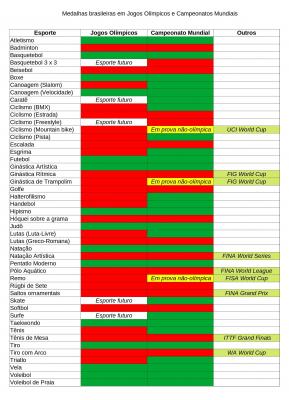
-
Thank you! Once again, a very detailed post! I'm trying to be as rational as possible about Fernando's chance of winning a medal. Weightlifting and Wrestling are the two sports I never expected anyone in Brazil to be able to actually get a medal at the World Championships or Olympics, but here we are in 2021 and Brazil has one medal at the WC in each of these sports. This is insane to me. If you told me 10 years ago that I'd be here predicting a medal for a Brazilian lifter, I'd laugh hard, but here we are. Thanks again for the update. I'll keep my focus more often on this sport now. It's exciting despite the many, many cheaters.
-
@MHSN I remember you posted a very detailed comment about how either Brazil, Algeria, Syria or Turkmenistan could possibly earn an Olympic medal for the first time, but I can't find it anywhere. Furthermore, this is a rough sport to follow because there are so many cheaters and disqualifications. However, let's see if I got some facts straight. If this ranking is up to date, this means that Fernando's biggest competition are Talakhadze (of course, since he's almost guaranteed to win gold), Davoudi and Minasyan, right? All of them, along with Ziaziulin, seemed to be very impressive to me in the last two World Championshis, especially Ziaziulin and Davoudi, for being junior athletes at the time. But since Armenia and Belarus can only take one lifter per gender, should I assume Minasyan and Ziaziulin will not be picked by them? If this is the case, then Toychyyev and Bidani are Fernando's biggest competitions for the bronze medal, right? Man Asaad should be a huge threat too, and I believe he will be awarded at least a tripartite invitation. I remember watching them at the World Championships and being impressed too. But all of them seem to be "beatable", at least in theory, unlike Talakhadze and Minasyan, and to some extent Ziaziulin and Davoudi, who both appear to be better than Fernando now. But if two of them -- Minasyan and Ziaziulin -- are out of the picture, then Fernando has a shot at a medal, right? The question is: will they be chosen by their federations? Are there any other contenders? Side note: I'm surprised to see Aramnau competing in this category. Didn't he compete in a lower weight class for, like, centuries? Why moving up to +109 kg now, especially with Ziaziulin and Belarus being able to send only one male lifter to the Olympics?
-
Weightlifting IWF World Championships 2018
thiago_simoes replied to Totallympics's topic in Weightlifting
I was right in the end. -
Yes!! Thank you for mentioning me. I've been waiting for this news for a long time! Amazing news!
-
Men's Handball IHF Olympic Games Qualification Tournaments 2021
thiago_simoes replied to Totallympics's topic in Handball
I'm surprised with Brazil qualifying! After the disastrous loss at the semi-final of the 2019 Pan Ams, only a miracle would let the team even reach the qualifying tournament, and only a bigger miracle would make them qualify, but hey! Look at what happened! I almost can't believe it! And what a bizarre way for Croatia not to qualify. I'm shocked. -
FIG has revised their qualification system. Well, not really revised, but mostly clarified some doubts. If the continental championships don't occur, remaining quotas will be allocated according to the best gymnast(s) from the all-around competition at the 2019 World Championships that still have not qualified. In short, if the continental championships don't happen, the following gymnasts will qualify: Men: Africa: AFIFY Mohamed METIDJI Hillal Americas: GONZALEZ Tomas MAYOL Santiago Asia: MUSSAYEV Akim AZIMOV Abdulla Europe: MOZZATO Niccolo JESSEN David Oceania: MORGANS Mitchell Women: Africa: DARIES Naveen SALEM Farah Americas: MAGISTRATI Abigail FIDELIS Thais Asia: AN Chang Ok EOM Dohyun Europe: BACHYNSKA Anastasiia KAESLIN Ilaria Oceania: NEDOV Emma
-
@heywoodu and @Laraja, if you are interested in how Portuguese and English differ when it comes to the Present Perfect, this article provides many examples about how crazy it is for speakers of Portuguese (especially Brazilian Portuguese) to grasp the notion of time behind the Present Perfect. The article is in Portuguese, but it provides a lot of sentences comparing Portuguese and English, so it might help clarify how different the languages are. This is also probably the biggest difference in grammar between Spanish and Portuguese, since Spanish has an equivalent structure to English. I know it works a little bit differently, but the notion of time behind it is roughly the same in Spanish and English. Not in Portuguese, though.
-
In English one can say: 1) She has broken the window. 2) She broke the window. In the first sentence, we know that the window is still broken, while in the second sentence it might have been fixed. In Portuguese we can only say "Ela quebrou a janela". This literally means "she broke the window", so the whole concept of something like "she has broken the window" is impossible to be carried over to Portuguese only using a verb form. We need to explain that it's still broken if we want to make sure that someone knows it needs fixing. To be honest, I believe that most people would immediately ask "tem que consertar?" or "does it need fixing?", but the thing is that in English, when we use the Present Perfect, it's very clear that the window is still broken, while in Portuguese we need to ask another question to make sure that it's still broken. Most people would assume by the context that it is broken anyway, but in order to make sure we need a second question, while in English this is not necessary. Now, there is an equivalent structure in Portuguese with the verb ter (have) + past participle of another verb, but it only works for specific situations. For example: Tem feito tempo bom. Literally: (It) has been weather good. As you might have guessed, this means "The weather has been nice", so it kind of works in Portuguese. But if you try to apply this to the first example, it makes absolutely no sense in Portuguese. "Ela tem quebrado a janela" (literally: she has broken the window) would raise many eyebrows as people would have no clue about what you want to say. I'd probably guess something like "she has been breaking the window again and again", but even so I'd use a completely different arrangement of words if I wanted to say something like this in Portuguese, like, for example, "toda vez que a gente coloca uma janela nova, ela quebra" (every time we set up a new window, she breaks it). There's also a form with andar (walk) + gerund. For example: Ele anda fazendo coisas erradas. Literally: He walks doing things bad. This means "he has been doing bad things". Of course, anda doesn't mean here that the person is walking, but instead it has the same meaning of Present Perfect in English, but it's not something that we can easily apply to "ela quebrou a janela" or "tem feito tempo bom", for example. It's like we're dealing with three completely different notions of time (even though "tem feito" and "anda fazendo" are not that different) in Portuguese, instead of a single notion of time in English like the Present Perfect. In short, often the meaning of sentences in the Present Perfect cannot be entirely replicated in Portuguese. I know these were not the best examples in the world, but I hope I was able to help, somehow.
-
I've been studying English for 30 years and I am an English teacher. I think in Portuguese, not English. When I'm speaking English or reading a text in English and I notice something that can't be quite clearly expressed in Portuguese, I think in English, but it's not like a random thought pops up on my mind in English if I don't have to use the language. When I think about things that I have to do, or when I have to come up with a solution for a problem, I think in Portuguese. Of course, I can switch languages and start thinking in English if I really want to, but it usually makes no sense for me to do this. The most interesting aspect of studying a different language is how I learned to deal with time in a different way. For example, the concept of Present Perfect is wildly different in Portuguese than it is in English. Portuguese usually expresses past actions as finished events; there's a form of Past Continuous, but this works like it does in English, for ongoing events in the past. It usually takes a lot of time and effort to teach students about the very concept of Present Perfect. This is something that Spanish speakers will never know because there's a form of Present Perfect in Spanish. Even Japanese has it. But not Portuguese -- at least, not exactly like it works in English. Japanese is my favorite language, by far, even though I'm not very good at it. I understand the basic concepts, and I understand most sentences if I use a dictionary, but it's still very difficult for me to come up with sentences on my own. I've never even felt like I could think in Japanese because it's still hard enough for me to say basic sentences. Still, it's a fascinating language.
-
Artistic Gymnastics 2020 Discussion Thread
thiago_simoes replied to thiago_simoes's topic in Gymnastics - Artistic
Yes, I got it. I know there was a mistake; but the very fact that there was a mistake completely screwed the competition, in my opinion. The judges were very bad and both Uctas and Iordache suffered with wrong difficulty scores. And this destroyed the climax because it gave hope for Uctas, but it was short lived. I used a VPN and it worked. Thank you for sharing. Really cute moment. -
Artistic Gymnastics 2020 Discussion Thread
thiago_simoes replied to thiago_simoes's topic in Gymnastics - Artistic
Yes, Mokosova's and Uctas's medals were probably my favorite moments of the whole competition. Slovakia has one gold and one silver medal at the Trampoline Gymnastics European Championships. Now, with this bronze medal, you guys have a full set. Well done. -
Artistic Gymnastics 2020 Discussion Thread
thiago_simoes replied to thiago_simoes's topic in Gymnastics - Artistic
That final floor routine left a sour taste in my mouth. It would have been a lot better if Uctas got gold and Iordache got silver, but the inquiry destroyed the climax. Overall, a terrible competition, by far one of the worst I've seen in my life. Still, kudos to the medalists, especially Turkey, Slovakia and Israel for their first-ever medals in women's artistic gymnastics. Kudos to Croatia and Bulgaria for medals in the junior division, too. -
Artistic Gymnastics 2020 Discussion Thread
thiago_simoes replied to thiago_simoes's topic in Gymnastics - Artistic
Ukraine won the women's team competition at the European Championships. It's a very surprising, almost shocking result, thanks to what Romania did. One of the Romanians scored very, very low on the uneven bars, but it was still possible for Romania to win gold. Larissa Iordache only needed, in theory, to hit her last routine on floor. If you watch her performance, you'll probably think she hit her routine, but there was a huge technical problem: she missed one of the requirements. Every apparatus has four different requirements, and these requirements add 0.5 to the difficulty score. The requirements on floor are: Connection of two dance elements (one must be a 180 degree split) Saltos forward/sideways and backward Double saltos Saltos with a minimum of one full twist Iordache performed only three out of four. She completely missed her third pass, and instead of two and a half twists connected to a front sommersault, she only performed two twists. This means that she never performed a salto forward or sideways. Now, this also happened in 2010 when Mattie Larson forgot to add a front salto to her routine and the US lost the world title to Russia. But, by now, gymnasts are fully aware of requirements and this silly mistake is unacceptable. Last week, Mai Murakami had this exact same problem, but she realized it and added a front salto at the very last pass during the Japanese National Championships. This is what we expected from Iordache, but in a very bizarre way, she forgot about such a basic thing. Kudos to Ukraine, though. I'm happy with a gold medal for them. And I'm glad Hungary got a team medal and Dorina Boczogo finally has a continental medal after all these years.




-
Who's Online 35 Members, 0 Anonymous, 716 Guests (See full list)
- Sindo
- Ludwig37
- Grassmarket
- De_Gambassi
- stepansevs
- avlar
- Quasit
- Mkbw50
- intoronto
- Jon
- Surlympics
- Federer91
- Jaymz
- OlympicIRL
- vinipereira
- Triplecast
- Jorn
- Bear Hollow
- Matej
- Styrka
- hckošice
- Andre Han
- Monzanator
- MinisterBHP
- Belle
- Wumo
- Jordi
- TeamGB
- Orangehair43
- Benolympique
- phelps
- erw
- cjsavory
- mester
- hoversaBR