
-
Register/Login on Totallympics!
Sign up to Totallympics to get full access to our website.
Registration is free and allows you to participate in our community. You will then be able to reply to threads and access all pages.
If you encounter any issues in the registration process, please send us a message in the Contact Us page.
We are excited to see you on Totallympics, the home of Olympic Sports!

hckošice
-
Posts
47,688 -
Joined
-
Last visited
-
Days Won
418
Content Type
Forums
Events
Totallympics International Song Contest
Totallympics News
Qualification Tracker
Test
Everything posted by hckošice
-
You mean the World Ranking ? https://www.issf-sports.org/competitions/worldranking/complete_ranking_by_event_yearly.ashx
-
perfect place for wedding, for sure.
-
yeah, definitely this sound like a place i want to live
-
Vadlejch
-
Congrats
-
Men's Ice Hockey IIHF Under 20 Division III World Championship 2022
hckošice replied to hckošice's topic in Ice Hockey
Saturday July 23rd, 2022 - Preliminary Round Day 2 Results (GMT -5) Group A: 17:00 Israel 4 - 6 Chinese Taipei 20:30 Mexico 4 - 1 Kyrgyzstan Provisional Standing After Day 2: 1. 5 2. 4 3. 3 4. 0 Group B: 10:00 Turkey 6 - 4 Bosnia and Herzegovina 13:30 Australia 13 - 1 South Africa Provisional Standing After Day 2: 1. 6 2. 6 3. 0 4. 0 -
Men's Road Cycling UCI World Tour 2022 (Tour de France)
hckošice replied to Totallympics's topic in Cycling - Road
Stage 21 Sunday - July 24th, 2022 h. 16:45 (GMT +2) ----------------------------------------------------------------------------------------------------------------------------------------------------------- Paris (La Défense Arena) - Paris (Champs-Élysées) 115.6km - Flat ------------------------------------------------------------------------------------------------------------------------------------------------------------- -
Men's Road Cycling UCI World Tour 2022 (Tour de France)
hckošice replied to Totallympics's topic in Cycling - Road
Stage 20 Saturday - July 23rd, 2022 h. 13:05 (GMT +2) ----------------------------------------------------------------------------------------------------------------------------------------------------------- Lacapelle Marival - Rocamadour 40.7km - Individual Time Trial STAGE CLASSIFICATION Wout VAN AERT 47:59 Jonas VINGEGAARD +19 Tadej POGACAR +27 Complete Standing HERE ------------------------------------------------------------------------------------------------------------------------------------------------------------- GENERAL CLASSIFICATION Jonas VINGEGAARD 76:33:57 Tadej POGACAR +3:34 Geraint THOMAS +8:13 ------------------------------------------------------------------------------------------------------------------------------------------------------------- POINTS CLASSIFICATION Wout VAN AERT 480 Tadej POGACAR 250 Jasper PHILIPSEN 236 ------------------------------------------------------------------------------------------------------------------------------------------------------------- CLIMBER CLASSIFICATION Jonas VINGEGAARD 72 Simon GESCHKE 64 Giulio CICCONE 61 ------------------------------------------------------------------------------------------------------------------------------------------------------------- YOUTH CLASSIFICATION Tadej POGACAR 76:37:31 Thomas PIDCOCK +57:34 Brandon McNULTY +1:27:43 -
Summer European Youth Olympic Festival 2022
hckošice replied to Totallympics's topic in Multi-Sport Games
1 Day to go... The awards (Medals in symbol of love (heart)) and a "demonic" mining sprite (associated with legends about permonics, which are demons that inhabit and guard our mines, but mainly protect and help the miners.) Hope we are not going to scare many young kids during the medal ceremonies though -
Yep especially for the insane taxes Was very well explained in one article in our news site about Slaf deal. First what is in the contract : Montreal gave him the maximum possible salary for a rookie: $950,000, ten percent of which is a signing bonus: $95,000. He signed a three-year contract, this length is given by default for rookies. In addition, he also has bonuses in his contract that allow him to receive an additional $3.5 million, which is again the maximum he can receive. In total, he can earn 4,450,000 in one season. It is the largest contract in NHL history for a rookie since the introduction of the salary cap in the 2005/06 season. However his only sure income, regardless of where he plays next season, is a signing bonus. He will receive the sum of 95 thousand dollars every year during the duration of the contract, even if he will play in Europe. The remaining 855,000 from the base salary will be in full if he plays the entire season for Montreal in the NHL. If he will be send down to Laval in the AHL, his salary would be $82,500. This amount also increased by $2,500. If he commutes between the NHL and the AHL, his salary will depend on how many days he will be in which competition. Overseas, they can earn a minimum of $177,500 (signing bonus + a full season in the AHL) from the base salary, or the full amount of $950,000. His contract also includes two types of bonuses. He can get a million for the first, 2.5 million for the second. With the first bonus, he will receive 250,000 for each of these fulfilled conditions. However, he can receive a maximum of one million in total. For example, if he fulfills five conditions, he will get nothing for the fifth. - score 20 goals - get 35 assists - score 60 points - to be in the TOP 6 forwards in the club in average time spent on the ice - have 0.73 points per game - in the rating +/- to be in the TOP 3 attackers of the club - at the end of the season to be in the rookie All-stars team - be nominated for the All-stars match - become the most valuable player of the All-stars match Under conditions where he must be top in something in the club or in points per game, he must play at least 42 games in the NHL. With the second type of bonus, he only needs to fulfill one condition to receive 2.5 million. - top 10 in the NHL among forwards in one of the categories: goals, assists, points, points per game (minimum 42 duels played) - win one of the trophies: Hart Trophy (Most Valuable Player of the Season), Maurice Richard (Best Scorer), Conn Smythe (Most Valuable Player in the Playoffs), Frank J. Selke (Best Defensive Forward) - nomination to the first or second All-stars team of the season. and now the reailty after Taxes: The mentioned numbers are significantly different from what Juraj Slafkovský actually gets on his account. The reason is simple - taxes. And that's not to mention other fees (agents, players' association, etc...). Looking at taxes, there is no worse city for a player in the entire NHL than Montreal, they are the highest here. If he played a full season in the NHL, reached all the bonuses and received the maximum possible amount of $4,450,000, he would pay up to 52.74 percent in taxes ($2,346,930). For comparison, if he had signed the same contract with the Seattle Kraken, he would have paid $736,000 less in taxes (36.20%). The percentage of taxes depends on the amount of earnings. The limit in Montreal when he would pay less than 50 percent in taxes is roughly 765,000.
-
Already 38 here now with literally 0 wind. The air is not moving at all... This is just Brutal, we simply are not used to that by default Our government prohibited from midnight any entrance to the forest in the whole Košice region..so there gone the last chance of a at least cooler air... https://www.kosice.sk/clanok/v-kosiciach-a-okoli-je-zakaz-vstupu-do-lesa
-
What are my flames doing ? first Gaudreau and now Tkachuk
-
Men's Ice Hockey IIHF Under 20 Division III World Championship 2022
hckošice replied to hckošice's topic in Ice Hockey
Saturday July 23rd, 2022 - Preliminary Round Day 2 Schedule (GMT -5) Group A: 17:00 Israel vs Chinese Taipei 20:30 Mexico vs Kyrgyzstan Group B: 10:00 Turkey vs Bosnia and Herzegovina 13:30 Australia vs South Africa -
And an Olympic appearance in Athens 2004 as well ! But, yeah, Well, it was always just a 1 man(in this case more a woman) show in fact, it seriously was a tree which hides the forest like our proverb says here Katarína Prokešová was our sole active athlete in this sport and it was more a fruit of German system than ours, She started the sport after moving with her parents to when she was still very young, She lived and trained there her whole career (she actually still live and work there if I am not wrong), basically her only connection with Slovakia was that she competed under our flag
-
Men's Ice Hockey IIHF Under 20 Division III World Championship 2022
hckošice replied to hckošice's topic in Ice Hockey
Friday July 22nd, 2022 - Preliminary Round Day 1 Results (GMT -5) Group A: 17:00 Kyrgyzstan 1 - 8 Israel 20:30 Mexico 5 - 6PSO Chinese Taipei Provisional Standing After Day 1: 1. 3 2. 2 3. 1 4. 0 Group B: 10:00 Bosnia and Herzegovina 1 - 12 Australia 13:30 Turkey 8 - 2 South Africa Provisional Standing After Day 1: 1. 3 2. 3 3. 0 4. 0 -
Man, they predict an even warmer day tomorrow How much I envy you your sea (I know, I know, it is not a sea it is a ocean blah blah blah...) ...
-
so the youngest member of our mini-mini-mini-mini-mini-mini-mini-mini-mini-mini-mini-mini team at the end achieved the best result and made at least some decent final point on our participation in Eugene. Well done Hana.
-
Summer European Youth Olympic Festival 2022
hckošice replied to Totallympics's topic in Multi-Sport Games
Approximately 120,000 portions of food, which represents more than 8 tons of ingredients per day for their preparation will be served in this canteen. The canteen, the construction of which took two weeks, is located in the front part of the Swimming pool on an area of approximately 12,000 m². The fully air-conditioned tent is approximately 4,000 m² area and consists of a kitchen (1,200 m²), a catering area for athletes and sports teams, as well as for the organizing committee. -
Men's Road Cycling UCI World Tour 2022 (Tour de France)
hckošice replied to Totallympics's topic in Cycling - Road
Stage 20 Saturday - July 23rd, 2022 h. 13:05 (GMT +2) ----------------------------------------------------------------------------------------------------------------------------------------------------------- Lacapelle Marival - Rocamadour 40.7km - Individual Time Trial ------------------------------------------------------------------------------------------------------------------------------------------------------------- -
Men's Road Cycling UCI World Tour 2022 (Tour de France)
hckošice replied to Totallympics's topic in Cycling - Road
Stage 19 Friday - July 22nd, 2022 h. 13:10 (GMT +2) ----------------------------------------------------------------------------------------------------------------------------------------------------------- Castelnau-Magnoac - Cahors 188.3km - Flat STAGE CLASSIFICATION Christophe LAPORTE 3:52:04 Jasper PHILIPSEN +1 Alberto DAINESE +1 Complete Standing HERE ------------------------------------------------------------------------------------------------------------------------------------------------------------- GENERAL CLASSIFICATION Jonas VINGEGAARD 75:45:39 Tadej POGACAR +3:26 Geraint THOMAS +8:00 ------------------------------------------------------------------------------------------------------------------------------------------------------------- POINTS CLASSIFICATION Wout VAN AERT 460 Jasper PHILIPSEN 236 Tadej POGACAR 235 ------------------------------------------------------------------------------------------------------------------------------------------------------------- CLIMBER CLASSIFICATION Jonas VINGEGAARD 72 Simon GESCHKE 64 Giulio CICCONE 61 ------------------------------------------------------------------------------------------------------------------------------------------------------------- YOUTH CLASSIFICATION Tadej POGACAR 75:49:05 Thomas PIDCOCK +51:26 Brandon McNULTY +1:22:39 -
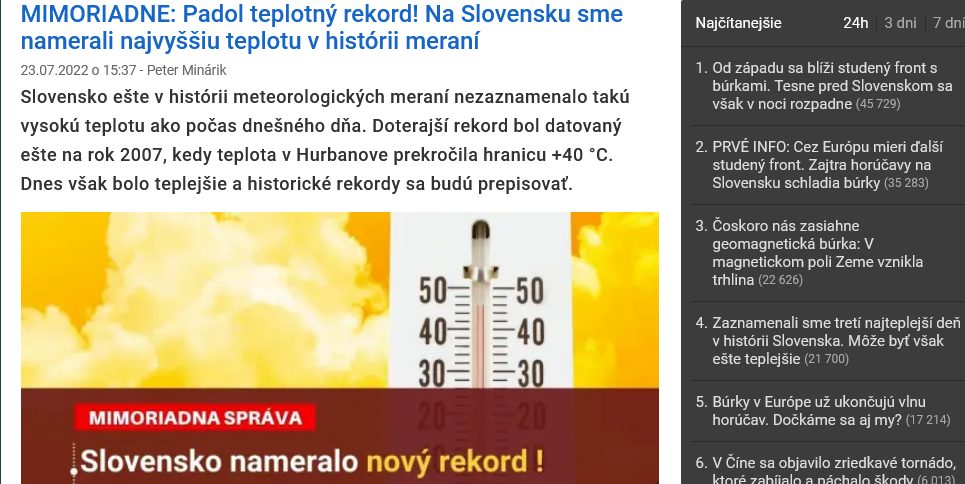
we have a time traveler in Slovakia ! I just looked on our meteo site to read about today´s new temperature historic record in Slovakia. At noon today we had +40,5 °C in one village near Hungarian borders. However the news about this came the 23rd July 2022 at 15:37 !!! Holy mother of Jesus ! Today we are the 22nd July ! Do you realize what happened ?
-
ATHLETICS
hckošice replied to hckošice's topic in Český a Slovenský Klub's CZE-SVK a Letné športy - Summer Sports
To hej, Forster je skvelý prísľub. Dúfam, že bude pokračovať v nastolenom tempe a postupne sa rozvíjať, bolo by ozaj fajn mať v budúcna šprintérku schopnú sa dostať na vrcholné podujatia, to sme nemali doteraz. Inak zvyšok, fakt bieda. No, uvidíme na ME, ako som písal, snaď tie naše áčka budú fit a bude aj nejaké finále. ČR malo vždy kopu talentov, nie je to prekvapenie, že vždy dokážete vytiahnuť nových nádejných atlétov. Nemám obavy o budúcnosť českej atletiky. -
Men's Road Cycling UCI World Tour 2022 (Tour de France)
hckošice replied to Totallympics's topic in Cycling - Road
nah, I think they are clean, no problem with that. But they seriously must eat some raw meat for breakfast or something, because this is seriously ridiculous how they are head and shoulders above everyone else in all things. Like really joking with everybody like adults competing against kids -
Men's Road Cycling UCI World Tour 2022 (Tour de France)
hckošice replied to Totallympics's topic in Cycling - Road
Impossible to not stop laugh about this Jumbo Visma team. -
Men's Road Cycling UCI World Tour 2022 (Tour de France)
hckošice replied to Totallympics's topic in Cycling - Road
panic in the peloton


-
Who's Online 17 Members, 0 Anonymous, 296 Guests (See full list)