
-
Register/Login on Totallympics!
Sign up to Totallympics to get full access to our website.
Registration is free and allows you to participate in our community. You will then be able to reply to threads and access all pages.
If you encounter any issues in the registration process, please send us a message in the Contact Us page.
We are excited to see you on Totallympics, the home of Olympic Sports!


Dolby
-
Posts
2,111 -
Joined
-
Last visited
-
Days Won
7
Content Type
Forums
Events
Totallympics International Song Contest
Totallympics News
Qualification Tracker
Test
Everything posted by Dolby
-
Don't fall for such charlatans. He is not even a good analyst.
-
We talk about end of "Pax Americana" meanwhile USA has taken down Syria, Venezuela and have started regime change in Iran. One by one Russia/China are losing key allies.
-
Congrats Italy.
-
Fully endorsed by the Nobel Peace Prize winner.
-
If Australia and New Zealand earn quotas through Pro League, then does that mean 3rd placed team from Oceania Cup takes quota?
-
-
Today Nobel Peace Prize will be declared. I can't decide what would be funnier: Trump winning the prize or his reaction on not winning the prize.
-

Cricket Discussion | Qualification to Summer Olympic Games Los Angeles 2028
Dolby replied to Totallympics's topic in Cricket
And that too in T20s, which was the last format in which they were good. Losing to Nepal by 90 runs is simply unimaginable. -
Leave aside nominations which mean nothing, there are a number of winners also who have not been very peaceful.
-
You can add Anderson Peters and Keshorn Walcott to the list of good javelin throwers from Cricketing nations.
-
CPN (UML) is ideologically very close to CPN (MC). They were seen as overground front of Maoist during civil war and were in alliance with Prachanda for quite some time. And since the end of civil war, apart from couple of years, PM has been from these 2 parties only.
-
Maoists have been the dominant political force. Why would they stoke it? Some of the internal groups not happy with status quo would be monarchists, Madheshi people of Terai region, other elites out of power like Rana family. Apart from these, there is a section which wants reversal to Hindu nation and a growing Christian population, both of whom would want bigger share of power. Just to clarify, not all groups, whether internal or external, would want overthrow of government. Some may want more rights, more power or a seat at table.
-
I am not saying that Nepal government handled the situation brilliantly, but a bunch of 20 year olds don't just burn the parliament without some direction. The way I see it is that a number of power groups (both internal and external) had been stoking the tension in Nepal for quite some time. The corruption and bad governance of the political class ensured that there was distrust for the elites in the public. In the present case, don't think Nepal banned the social media but asked those companies to adhere to local laws which they refused to do. So, sensing an opening, some of the power groups, would have provided the framework for large scale protests. But don't think anybody anticipated the situation to worsen so quickly. Now, am hearing reports that Army is trying to control the situation but there is still fear in Kathmandu, specially among elites. It would be interesting to see which way does Nepal go from here. They were absolute monarchy till 50s with varying degrees of reform resulting in constitutional monarchy in 1990. And at this time, the King was very popular. But, this changed first with the Maoist led civil war and later with the royal massacre. Now, the king has been deposed, Maoists have joined politics and have been the dominant political force. So, where does Nepal go? Back to King Gyanendra, who is not as popular as previous kings but still has loyalty or Maoists, who have failed to provide any stability? Or will it be the elites of Koirala or Rana clan who will emerge as dark horses?
-
Meanwhile situation in Nepal is highly volatile as "Gen-Z Protestors" there have forced PM to resign. Yesterday, not only was the Parliament and houses of PM and many other politicians burned, many top politicians were beaten by mobs on streets. Wife of an ex-PM was burned alive as well. Myanmar, Afghanistan, Sri Lanka, Bangladesh and now Nepal. All governments toppled by either coup or protests in last 5 years. Plus all the drama around Imran Khan in Pakistan.
-
Am I the only one who is irked at wrong position of New Zealand?
-
Insane results. 633.4 not enough to qualify for finals.
-
I hope apart from the Qatari plane, Trump can also claim the reward on Al-Jolani.
-
But but you were saying that India attacked Pakistan........
-
Exhibit 3: Naive Westerners: "This conflict is about resources" Pak Army: "Islam is not just our personal belief but part of our training. 'Iman, Taqwa, Jihad fi Sabilillah' is our motto. The operation name 'Bunyan ul Marsoos' signifies that we, the Muslims who are fighting for Allah are like a steel wall.
-
Exhibit 2: Pakistan's DG ISPR (whose father, let me remind you, is a UN designated terrorist) inadvertently confirming that the person leading the funeral of mastermind of IC-814 hijacking is indeed a terrorist. And the same funeral was attended by 3 star General of Pakistan Army.
-
Recent press briefings of Pakistan Army have been so revealing. Would try and post as many gems from them as possible. Exhibit 1: Pakistan Air Force admits "tactical Brilliance in Pulmama" To those who don't know what Pulwama terror attack was, it was a terror attack on Indian military convoy on Feb 14 2019, resulting in death of 40 Indian soldiers.
-
May God continue to give such historic wins to Pakistan
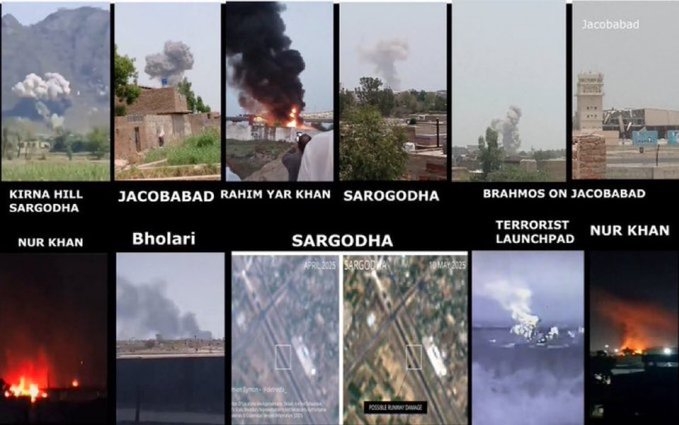
-
Oh well it seems Munir has a death wish. So be it.
-
India agrees to a ceasefire after Pakistan begs for it.
-
This was the headline of Dawn, the biggest newspaper of Pakistan on Dec 17, 1971 This is General Niazi surrendering to India on Dec 16, 1971




-
Who's Online 20 Members, 0 Anonymous, 240 Guests (See full list)